September Client of the Month: Artist & Entrepreneur Eleuthera
Our September Client of the Month is Eleuthera, a multidisciplinary artist, musician, photographer, and founder of Sanctuary, a healing arts space in Verdun. With more than two decades of experience as a performer and creative entrepreneur, Eleuthera shares her journey, the challenges she’s overcome, and how YES helped her build community and confidence as a self-employed artist.
About Eleuthera
Eleuthera has over two decades of professional performance and recording experience as a vocalist, touring solo and with her former vocal trio, Fruiting Bodies, across North America, Uruguay, and Iceland. She has trained with gifted performers including Rhiannon, Margie Gillis, Bobby McFerrin, and Zakir Hussain at Carnegie Hall.
She has over a decade of experience directing community choirs, including the NDG Singing Circle, the Phoenix Community Choir, and co-directing the OK Chorale.
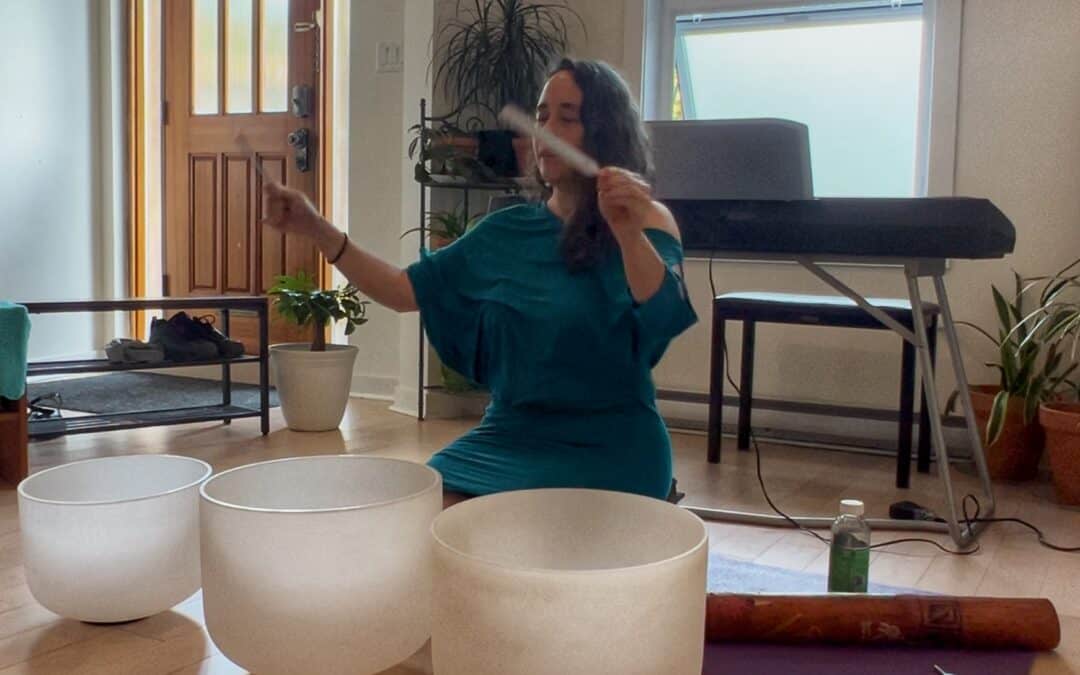
She is currently a full-time singer-songwriter, choir director, sound healer, and photographer, offering regular house shows, community sings, and sound baths at her healing arts space, Sanctuary, while preparing for her interdisciplinary exhibit on the immigrant experience, Entre Mundos.
When did you start your artistic journey, and what were some of your goals when you started?
My mother was a music teacher, so my artistic journey started young. I was around two years old when I started playing piano, and I was always singing to myself. I started voice and piano lessons when I was six and began performing then. When I was eighteen, I started playing open mics, singing Fiona Apple and Etta James covers. Soon after that, I started singing in bands.
That was when the journey became my own, and I decided to make a career out of it.
I don’t think I had many concrete goals related to my music career when I first started out. It’s always been about dedicating myself to it and seeing what happens. I just wanted to sing, let loose, and explore my body as an instrument, my ability to channel and improvise, get out of the way, and let something greater move through me. I think, deep down, that’s what I want now too.
What stage are you at now? What have been your greatest achievements?
Now I’m a full-time self-employed interdisciplinary artist, a place I never could have dreamed of being. It’s pretty incredible!
Some of my greatest achievements in the past were playing bigger festivals, like Osheaga and the Ottawa Blues Festival, touring extensively throughout North America, Uruguay, and Iceland, and directing larger choirs like the OK Chorale, an 80-person pop-rock choir.
More recently, I’ve been embracing myself as an interdisciplinary artist and prioritizing my photography more as a way to reconnect with my estranged Uruguayan family and better understand what they lived through during the dictatorship, immigration to Canada, and return to Uruguay.
My first photo exhibit in 2020, Ecos y Transparencias, explored those themes, and I recently received my first Canada Council grant for my interdisciplinary project Entre Mundos, which explores the immigrant experience through photographs, music, and interviews.
My greatest achievement to date has been opening a community healing arts space in Verdun called Sanctuary. I host and perform house shows there, lead weekly community sings, offer sound baths and one-on-one sound healing sessions, and welcome other teachers who offer yoga classes and workshops. The space also features monthly artist exhibitions. It’s an absolute dream come true.
What were, or are, your biggest struggles?
As many artists can probably relate, my biggest struggles have been around money and burnout.
I would play bar gigs, and we would be paid in exposure and beer. That would be fine if we could pay rent with that, but we can’t. It leads to poverty and alcoholism for far too many musicians. It breaks my heart.
And it leads to burnout. We are encouraged to hustle. But hustling for gigs that pay close to nothing doesn’t build a portfolio or character. It just depletes us.
It was a major turning point for me when I decided to stop playing free gigs. Once or twice, I missed out on opportunities because of it, but most of the time I felt that people respected me more as a professional, and it ultimately led to more paid opportunities.
What was the problem you were experiencing before coming to YES?
When I came to YES, I had just quit my day job and was very burnt out. I had decided to take the leap and become a full-time self-employed artist. I’ve often found being an artist to be quite solitary, and YES changed that.
What did you gain from using our services? What was the best part?
I have met so many wonderful artists at YES events, and we’ve actually exchanged contact information and stayed in touch. Claudia Dufour Marquez, whom I met at the YES conference this past April, is now exhibiting her series Ce que l’on cache / What We Hide in my space. Juliana Cortes, whom I met at a YES grant workshop, will be offering a Decolonizing Health workshop here on September 12. I have artistic community, and that means the world to me.
The artist coaching with Caroline Gauthier has also drastically changed my life. I have support that I’ve never had before. Someone to talk with about my website, marketing plan, grant applications, and more. Someone to offer a different perspective, reflect things back to me that I hadn’t noticed, and help me move forward when I’m feeling stuck. It’s been a game changer.
How do you feel about the service you have received from YES?
All of the YES services I’ve experienced have been amazing. The workshops and coaching are professional, affordable, and everyone has been so kind.
Do you have any final thoughts you’d like to share?
A lot of us struggle with internalized cultural narratives about what it means to be an artist: that it’s just play and not real work, or that we have to starve and scrape by in order to create anything of artistic merit.
I think we have to overcome these narratives and remember that art is work, that what we do matters, and that we can make a living doing it. We can thrive as artists without compromising our work. In fact, having a solid financial foundation is necessary to build a thriving artistic practice and career.
And we’re not alone in it. There are so many artists who understand our lived experiences and so many organizations out there to help. Thanks so much to the YES team for this opportunity to share my story and for all that you do.
To learn more about our services for Artists, click here.